Thornton Willis: Unbound
November 19, 2026 – January 8, 2027
Monday-Friday, 10am-5pm by appointment only
447 Space and the Estate of Thornton Willis are honored to announce the first exhibition of the artist’s work since his death in New York City on June 15, 2025. Unlike any of his solo exhibitions during his lifetime, this presentation will show the paintings unstretched. After the artist’s passing, the estate made an unexpected discovery: eighteen canvases, each stored on its own roll in a large overhead unit in his studio. Dating from the late 1960s through the 1990s, the works are in remarkably pristine condition. They will be presented as found, off stretcher bars, with their raw edges exposed.
Many of these paintings are monumental in scale, a hallmark of Willis’s practice throughout his career. Speaking at the artist’s funeral, his friend, the painter Neil Jenney, addressed Willis’s scale and his reintroduction of colored volumes: “I think Willis’s intuitive precision spatially and chromatically was supreme-plus the introduction of powdered pigments on the flats-and the offering of excited edges to the shapes put him past the others. Add to this his courage to approach a dimensional scale—which I describe as ‘Full Grown’—when others avoided the extra-large as unsellable, sets him apart.” Willis mixed his own paint by hand, allowing him to achieve unusually rich, bright, and lasting color.
In the late 1960s, Willis was a neighbor and friend of Gordon Matta-Clark, Alan Saret, and Richard Serra, and exhibited at Paley and Lowe Gallery, which also represented Lynda Benglis. These sculptors were exploring ideas about art-making that became known as Process Art. To adapt these ideas to painting, Willis worked on wet canvas on the floor using rollers attached to long handles to make his Slat paintings. Some early examples of this breakthrough work are held in the collections of the Whitney Museum of American Art, the Birmingham Museum of Art, and the Paley Center for Media. Three examples from 1967 to 1969 are in this exhibition.
Along with a handful of other painters in the early 1970s, Willis worked his way out of Minimalism’s corner and reopened painting’s potential to the evocation of profound human emotion. Through color and visible brushwork he created intimacy on the surface of even his largest pieces. From the mid-1970s into the 21st century, Willis went back to painting on stretched canvas using brushes and honing his touch. He then championed Figure-Ground painting, which embraced both his Wedges and, later, the solid geometric rectilinear forms found in his Cityscapes. He also explored multiple triangles or “fractals” and what he termed “Biomorphic Cubism.”
As a self-described “Third Generation Abstract Expressionist,” he favored action painting and combined the immediacy of gestural painting with a cooler reductivism to create a visual dynamic arising from the tensions between the two modalities, stopping just short of resolution. As a result, these works appear timeless and fresh, and they participate in an ongoing posthumous dialogue with Piet Mondrian and Willem de Kooning, among others he admired or knew. As Willis wrote, “The best painting is always open-ended. It asks questions and partners with the viewer to bring the experience to closure, or it might excite another painter to respond; this is what I aim for in my work.”
Thornton Willis was represented for several decades by Elizabeth Harris Gallery in New York City and Claes Nordenhake Gallery in Stockholm, Sweden. He participated in exhibitions at Sidney Janis Gallery, André Emmerich Gallery, Gagosian, the Museum of Modern Art, the Whitney Museum of American Art, the Ateneum Art Museum (Helsinki), the Power Institute Foundation for Art and Visual Culture at the University of Sydney, Musée des beaux-arts (La Chaux-de-Fonds), and the Malmö Konsthall (Malmö), among many others in the US and abroad.
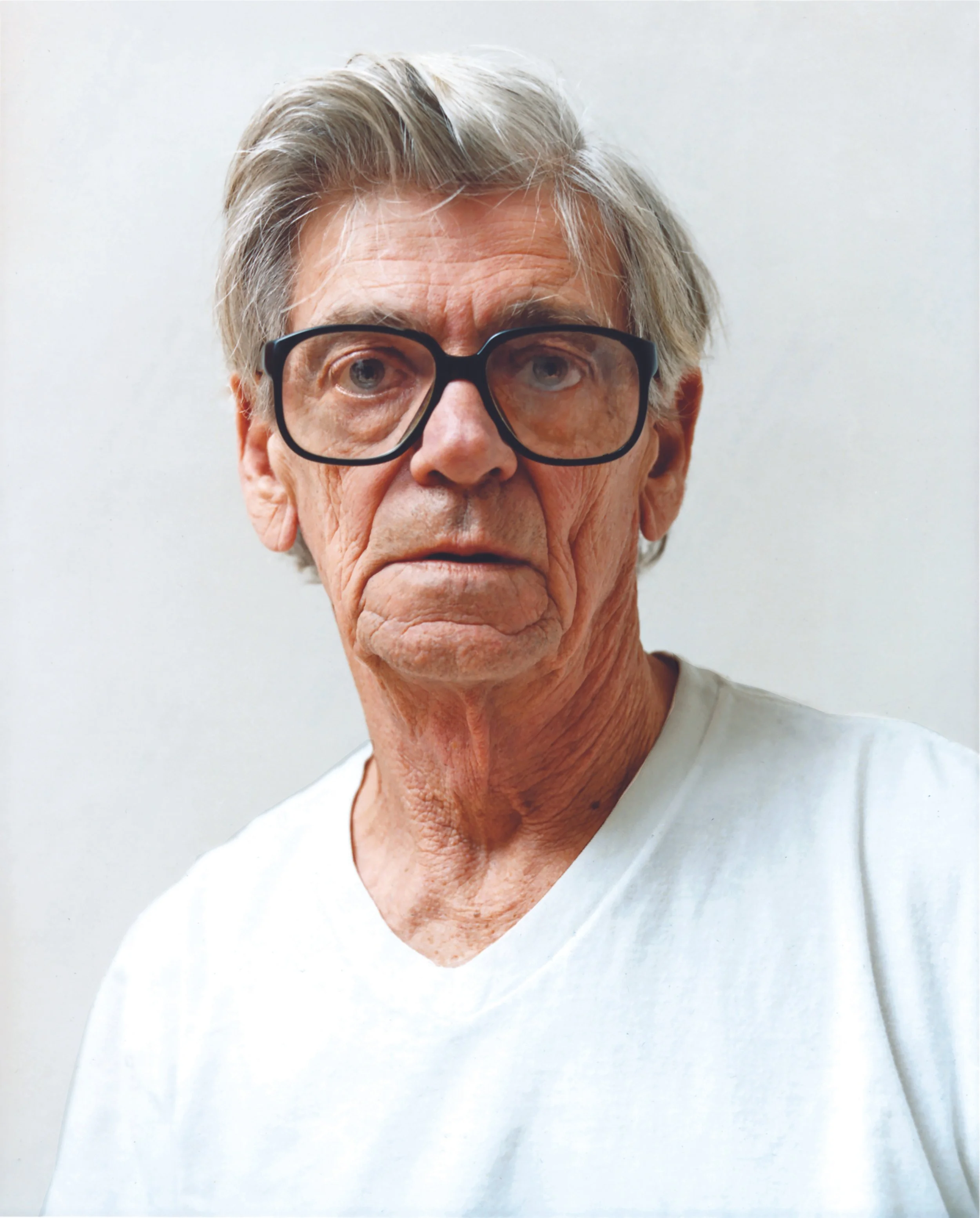
Portrait of the Artist

"Red Kicker," 1985, Acrylic on canvas, 60 x 48 inches